
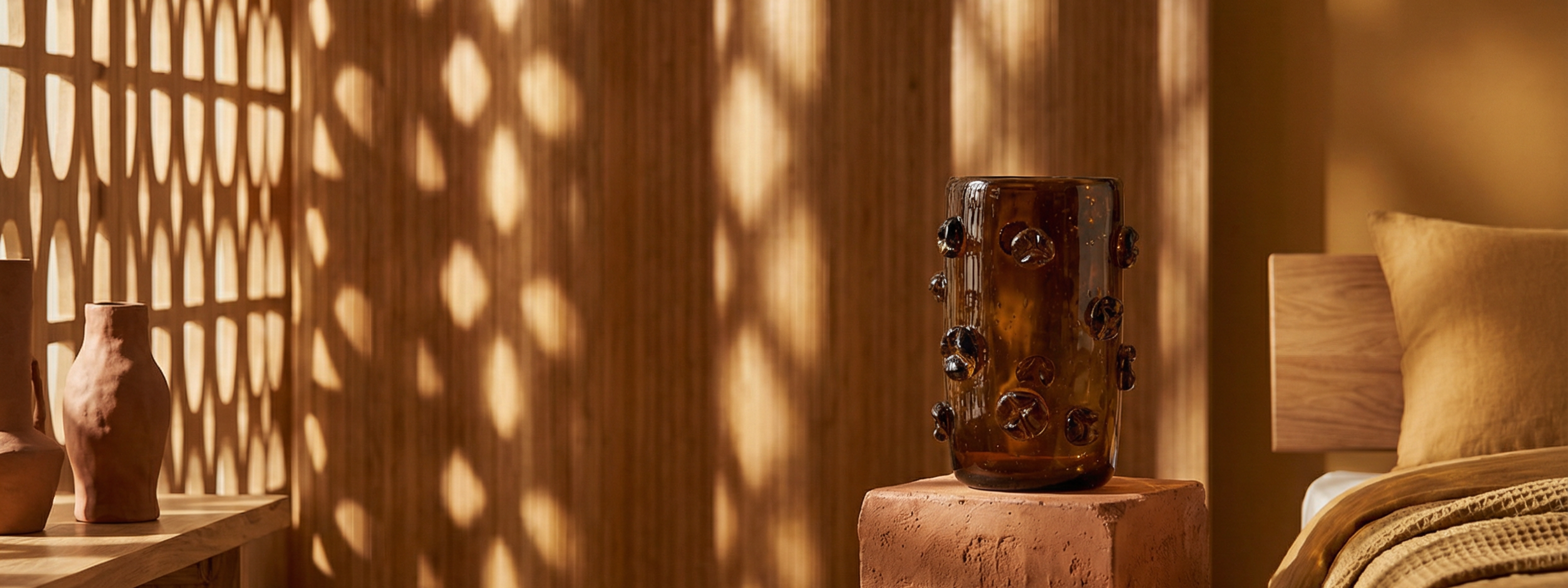
The Nywele Vase, A Story of African Handblown Glass from Kenya
September Collective — Origin Story
The
Nywele
Vase
From a search with no answer, to a word that meant everything.
Written by Leslie Rivers, Founder of September Collective

01 The Search
Beautiful was not
the same as meaningful.
I was searching for glassware for September Collective, something that could hold its own alongside the handcrafted pieces the brand had been built around. The search produced results. Beautiful ones, even. What I found were the typical offerings. Some with colour. Some with texture. A few that gestured toward something more. But none with a story. None with a maker you could name. And none that felt truly representative of the cultures and craft traditions I had built this brand to honour.
And then I came across Kitengela Glass, an artisan hub in Nairobi, Kenya, where glassblowing is practised entirely by hand using recycled glass. What they were doing stopped me. African artisans have always found ways of making do under conditions that were never imagined or meant to produce great art. And yet, from those very constraints, something extraordinary emerges. Kitengela was proof of that. The work was alive. And I knew immediately that this was who I wanted to create with.
The question was no longer where to find the right glassware. It became: what could we make together?

02 The First Prototype
The moment I thought:
"I have no idea
what I'm doing."
The inspiration was clear from the beginning: the Bantu knot. A hairstyle rooted in African tradition, worn across generations, shaped by the hands of women who understood that beauty was never just aesthetic. It was cultural, political, personal.
I sent Kitengela images of women with Bantu knots and asked a simple question: can you create a vase that looks like this? They could. What came back was round, full of nodules, technically faithful to the reference. And entirely wrong.
Standing there looking at it, I thought: I have no idea what I'm doing. The disappointment was real. But so was the clarity that followed. The idea had a direction. It just needed a different form. More height. More restraint. The Bantu knot's essence, not its literal translation.

The wrong version had to exist before the right one could be seen.
|
The Design Journey I went back to the drawing board using the first prototype as my reference point. I asked for more height, more length, fewer nodules. Less busy. A rhythm rather than a pattern. Something closer to suggestion than statement, and closer to what I had been trying to say all along. |
The Making Process At Kitengela, molten glass is gathered from the furnace and shaped entirely by hand, with no moulds and no shortcuts. The nodes are applied one by one while the glass is still hot, requiring precision, timing, and an intuition that only comes from years of practice. Each piece develops in the hands of the artisan. No two will ever be the same. |
03 The Uncertainty
Certain about two.
Unsure about one.
When the revised photographs arrived, something had shifted. Umber, with its warm amber tones that deepen in afternoon light. Onyx, bold, architectural, quietly commanding. Both felt right immediately.
But Moss gave me pause. The deep sage green, organic and considered, refused to resolve itself in photographs. It was the one colourway I could not decide from a screen. It would have to wait.
Kitengela, throughout all of this, never simply executed a brief. They brought their own creative intelligence to every exchange. Open, generous, genuinely invested in what we were building together. This was their craft, their mastery, their work. Our role was to bring the vision and trust them completely with the making.
 |
 |
04 The Arrival
The shipment arrived.
The question
finally answered itself.
My first in-house designed product had crossed an ocean. It had existed as an idea, a reference image, a disappointment, a revision, a photograph, a decision held in suspension. And now it was here, in a box, in my home.
When I opened the packaging, the uncertainty of months resolved in an instant. They were beautiful. All three of them. Umber, warm and grounding. Onyx, still and commanding. Moss, the one that had refused to commit on a screen, alive and fully itself in the light of a real room.
No two pieces were identical. Because they cannot be. I had always known that was part of the story. Holding one, I understood exactly why.

05 The Name
The object existed.
Then came the word.
The vases were here. They were beautiful. But I still didn't know what to call them.
I began searching for a name, something meaningful, something that sounded as beautiful as the form it described. The search led me to Swahili. And there it was.
Nywele. Hair.
A single word that completes the full arc of the journey. From images of women with Bantu knots, to recycled glass shaped by hand in Nairobi, to a vase that carries the language of that tradition in its very name. The Bantu knot had inspired the form. Nywele gave it its identity.

This is what I was always building toward. Not just a product, but a piece with a name, a maker, a meaning, and a place in the home that cannot be filled by anything else. September Collective will never take credit for what an artisan's hands have made. Our role has always been to honour the craft, share the story, and connect the maker with the people who will carry their work home. Nywele is that promise, made into an object.
The most meaningful things are never rushed. Nywele is the result of patience, craft, and intention.
Shop the Nywele VaseSeptember Collective
Leave a comment
This site is protected by hCaptcha and the hCaptcha Privacy Policy and Terms of Service apply.