


The Case Against More: The Art of Choosing Well
September Collective The Journal
The Case
Against More.
Why the things that matter most are made slowly, by people who care deeply about what they leave behind.
Written by Leslie Rivers, Founder of September Collective | June 2026 | 5 minute read
01 The Search
Something is quietly changing.
There is a quiet revolution happening in the homes of people who are paying attention. It does not announce itself loudly. It looks, instead, like a handblown vase made from recycled glass that catches the morning light differently every day. A basket that took one person three weeks to weave. A stool that carries the memory of a tree. A lamp that began as a piece of discarded wood.
It is a turning away from more, and a turning towards meaning.
But meaning is only possible when what you are holding is real. And that is where things get complicated.
02 The Problem
The problem with "handmade"
Somewhere along the way, the words we use to signal quality stopped meaning what they once did. Handmade. Artisan. Small batch. Ethically sourced. They appear on everything now, on products made in factories, on labels designed to suggest a story that does not exist, on things produced quickly and cheaply and dressed in the language of craft to justify a higher price tag.
If you have ever brought something home because of what it claimed to be, and later wondered whether that was true, you are not wrong to wonder. For anyone seeking truly ethical home decor, that landscape is particularly hard to navigate. And that uncertainty has a cost. Not just financially, but in the quiet disappointment of owning something that does not hold the weight you hoped it would.
This is the real case against more. Not more buying, more scrutiny. More questions. More insistence that the things you bring into your home are exactly what they say they are.
One object made slowly, by someone you can name, in a place you can point to, will outlast ten things that had none of those answers.
At September Collective, we do not carry a maker until we understand them, their process, their people, their place. Not because we are purists, but because we know that when you bring something home from us, you should be able to tell the full story of it. That standard is not incidental to what we do. It is the whole point.
03 The Makers
Objects with a story you can tell
Across every piece you find here, whether it is a handwoven basket, a sculptural object, or a furniture piece, that consideration is the same. But for me, it goes further than research. Before September Collective ever carries a maker's work, I request samples. I bring them into my home, live with them, and study how they hold up and how they feel in my hands. That personal review is not a formality. It is the standard. When a sample does not meet our standard, we are transparent about it and we move on. Every maker you find at September Collective is here because their work genuinely earned its place.
These are a few of their stories.
Founded in 2000 by Josephine and Kweku Forson and now led by their daughter Audrey, Tekura is a family business built around a single belief: that African design belongs on the world stage, and that it should get there on its own terms. Working with skilled local artisans in Accra, Tekura handcrafts furniture and décor from recycled and responsibly sourced wood, drawing inspiration from the Ashanti and Fanti cultures. Their Djembe Table was featured in the film Black Panther: Wakanda Forever. When craft is this considered, the world takes notice.
Discover TekuraFounded by Candice Lawrence in Cape Town, Modern Gesture is a design studio that finds beauty in what others might overlook, wood offcuts, wax cord, reclaimed metals. From these materials, Candice and her team craft lighting, homeware, and objects that carry a distinct African sensibility while feeling entirely contemporary. Each piece is made slowly, with experimentation at its heart. Every variation in texture or form is part of the work, not a flaw in it.
Shop Modern GestureIn Bolgatanga, a city in Ghana's Upper East Region known simply as "the city of baskets", a community of over 250 Gurunsi artisan weavers practise a tradition that is older than anyone can remember. Baba Tree works directly with these weavers, honouring the Bolga basketry techniques passed through generations while creating space for new patterns and forms to emerge. Made from elephant grass using each artisan's own rhythm and flow, every basket is a singular object. A handprint. A signature. A piece of someone's time that now lives in your home.
Shop Baba TreeAt Kitengela Glass in Nairobi, one of Kenya's most celebrated glass studios, every piece begins with fire. Artisans gather molten recycled glass on the end of a blowpipe and, through a process of breath and rotation refined over years of practice, coax it into form. No mould dictates the shape. No machine repeats it. The process itself decides where each piece goes, and it is never the same twice. Our Nwele Vase Collection was made here, born from a collaboration between September Collective's in-house design and Kitengela's mastery of the furnace. What arrives in your home is not just an object. It is a record of someone's breath.
Explore the Nwele Collection04 The Standard
The standard worth setting
What connects these makers is not just geography or material. It is the fact that we can tell you exactly who made what you are holding, how it was made, and why it will not fall apart in two years. That is not a small thing. In a market full of approximations, it is everything.
Small batch African design is not a trend. It is a commitment to a different way of making entirely. The philosophy is simple, and it will save you money over time: buy one thing made with full attention, by someone who had no interest in cutting corners, and it will outlive a dozen things that were not. The object you chose carefully five years ago is still on your shelf. The one you bought quickly is gone, and you cannot remember what it looked like.
Buy once. Buy well.

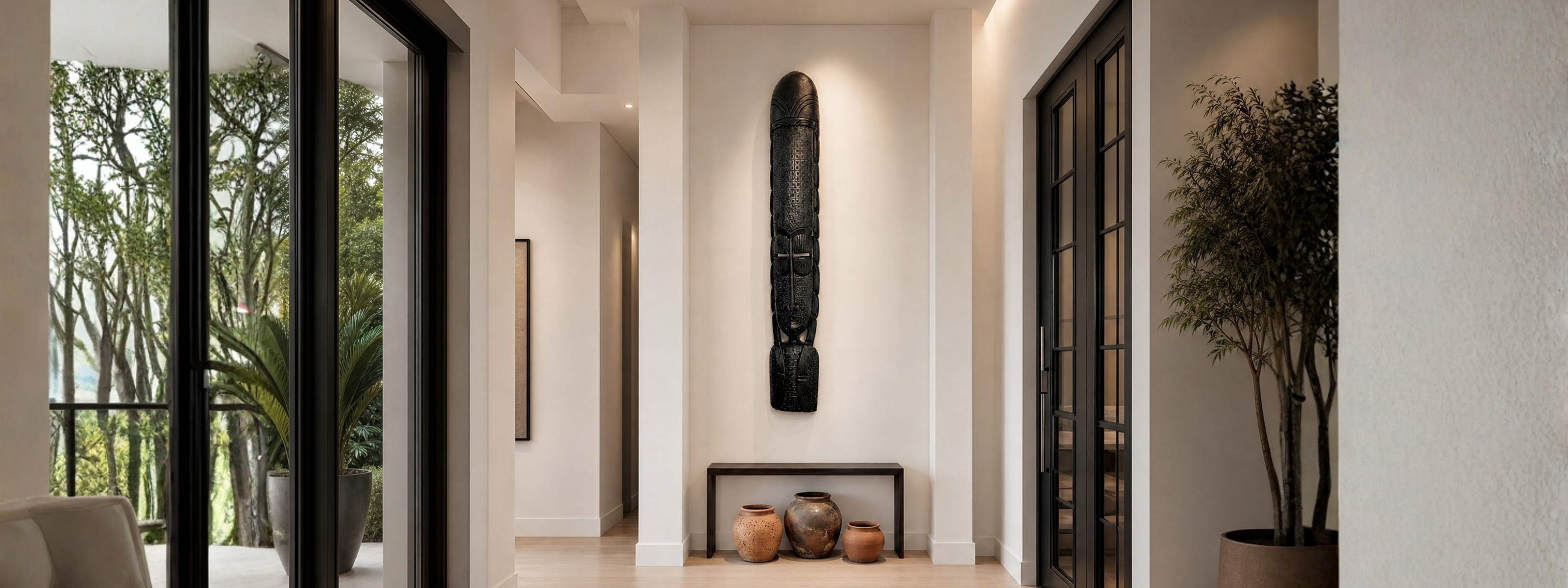
Tekura Designs · African Warrior Female Sculpture · Accra, Ghana
So here is the standard we would offer you. Before you bring something home, ask three questions: Do I know who made this? Can I tell the full story of it? Will I still want it in ten years? If the answer to all three is yes, you are not spending more. You are spending once.
And if the question of who gets credit for African design resonates with you, we explored it further in our editorial Black History Month Begins at Home.
The most meaningful things are never rushed.
Leave a comment
This site is protected by hCaptcha and the hCaptcha Privacy Policy and Terms of Service apply.